
If you’ve spent any time in the power industry, you know the cycle: a whitepaper comes out promising “limitless” energy density with zero degradation, some VC firm pours $50 million into a startup, and three years later, we’re left with a pile of expensive scrap metal and a lot of NDAs. Enter Superconducting Magnetic Energy Storage (SMES).
On paper, SMES is the holy grail. It stores energy in the magnetic field created by the flow of direct current in a superconducting coil. Since there is zero resistance in the superconducting state, you theoretically have 95%+ round-trip efficiency and near-instantaneous power delivery. But if you’ve ever tried to keep a multi-Tesla magnet at 4 Kelvin while the ambient temperature outside the cryostat is hitting 40°C, you know that “efficiency” is a relative term.
The Problem Nobody Talks About
The industry loves to talk about the “infinite” cycle life of SMES. Unlike lithium-ion, which starts dying the moment it leaves the factory floor—a topic we covered extensively in our piece on battery-degradation-warranty-lies—SMES doesn’t care about depth of discharge or cycle counts.
However, the “nobody talks about it” part is the cryogenic overhead. You aren’t just storing energy in a coil; you are maintaining a delicate thermodynamic equilibrium. If your cryocooler hiccups for even a few milliseconds, you don’t just lose power; you face a quench.
I once consulted on a pilot project where a minor vacuum leak in the insulation jacket caused a localized heat spike. The superconducting transition temperature was breached, the wire went resistive, and the energy stored in the 50MJ magnetic field had nowhere to go but into the liquid helium. The resulting pressure rise blew the rupture disks off the cryostat and turned a $2M installation into a very expensive, very loud paperweight in about 12 milliseconds.
Technical Deep-Dive
At the core of an SMES system is the superconducting coil, the Power Conversion System (PCS), and the Cryogenic Refrigeration System. The energy stored ($E$) is defined by $E = 0.5 \cdot L \cdot I^2$, where $L$ is the inductance and $I$ is the current.
 Image Credit: energybases.com
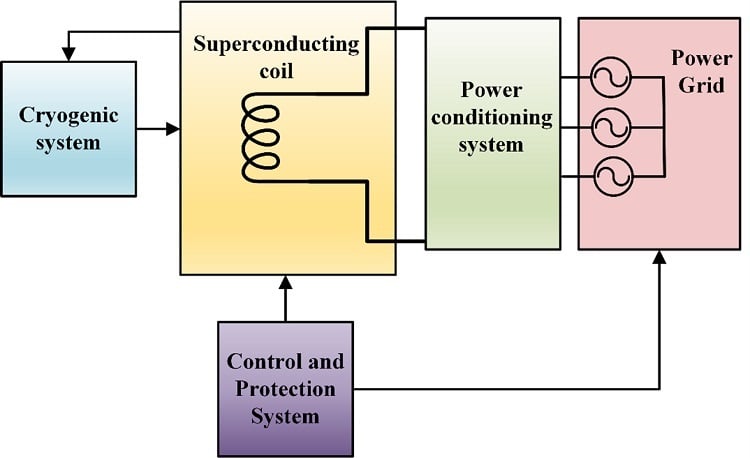 Image Credit: fity.club
 Image Credit: huntkeyenergystorage.com
To make this work, you need high-temperature superconductors (HTS) like YBCO (Yttrium Barium Copper Oxide) or low-temperature superconductors (LTS) like NbTi. The PCS is typically a Voltage Source Converter (VSC) that handles the DC-to-AC conversion.
Comparison of Storage Characteristics
| Parameter | SMES | Li-Ion BESS | Flywheel |
|---|---|---|---|
| Response Time | < 10 ms | 100-500 ms | 50-100 ms |
| Cycle Life | > 100,000 | 3,000 - 10,000 | 20,000+ |
| Self-Discharge | High (Cryo-load) | Low | Moderate |
| Energy Density | Low | High | Low |
The primary technical bottleneck is the cryogenic duty cycle. Even when the system is idle, the refrigerator must run. If your grid application doesn’t require high-power, short-duration bursts (like sub-cycle frequency regulation), the parasitic load of the refrigerator will eat your ROI faster than a chemical fire in a lithium rack.
Implementation Guide
Implementing SMES requires a rigorous approach to control loops. You aren’t just managing current; you are managing the stability of a superconducting state.
graph TD
    A["Grid Interface"] -->|"DC Link"| B["Power Conversion System"]
    B -->|"Cryogenic Monitoring"| C["Superconducting Coil"]
    C -->|"Thermal Feedback"| D["Cryocooler Control"]
    D -->|"Quench Detection"| B
    B -->|"Active Power Dispatch"| A
When designing the PCS, focus on the Quench Protection System (QPS). This is the most critical piece of code you will ever write. If the voltage across the coil segments exceeds your threshold (typically a few hundred millivolts), you must trigger an active discharge into a dump resistor immediately.
Failure Modes and How to Avoid Them
- Quench Propagation: This is the “thermal runaway” of the SMES world. If a section of the coil goes normal, the resistive heating propagates at the speed of sound through the conductor. Use high-speed fiber-optic strain and temperature sensors to detect the onset of a quench before it destroys the coil geometry.
- Vacuum Integrity: You are dealing with liquid helium/nitrogen. Even a microscopic leak in the vacuum jacket will lead to ice formation on the coil, which creates thermal bridges. Monitor the vacuum pressure constantly. If it drifts above $10^{-5}$ Torr, initiate a controlled ramp-down.
- PCS Harmonics: Because you are dealing with massive inductances, the switching frequency of your VSC can interact with the coil’s parasitic capacitance, leading to unexpected oscillations. Ensure your damping filters are tuned for the exact inductance of your specific coil configuration.
When NOT to Use This Approach
If you are looking for long-duration energy storage (anything over 15 minutes of discharge time), SMES is the wrong tool. The cost of scaling the cryogenic system for larger coils scales non-linearly. You’ll be paying for cooling capacity that you aren’t using.
If your use case is simply energy arbitrage or peak shaving, stick to traditional battery-energy-storage-systems. They are cheaper, easier to maintain, and don’t require a PhD in cryogenics to keep operational.
SMES is a specialized tool for power quality and transient stability. Use it where you need massive power injection for a few seconds to prevent a grid collapse. It is a scalpel, not a sledgehammer.
Conclusion
SMES is technically fascinating, but it is an engineering nightmare for the faint of heart. It requires a level of operational discipline that most modern utility operators simply aren’t equipped to provide. If you have the budget, the specialized staff, and a legitimate need for micro-second response times, it’s unbeatable. But if you’re just trying to solve a standard load-leveling problem, save yourself the headache and buy a containerized lithium system. Just don’t say I didn’t warn you when the cryo-pump fails on a Sunday night.
Hero image: Some factories on the drive to south padre.. Generated via GridHacker Engine.


